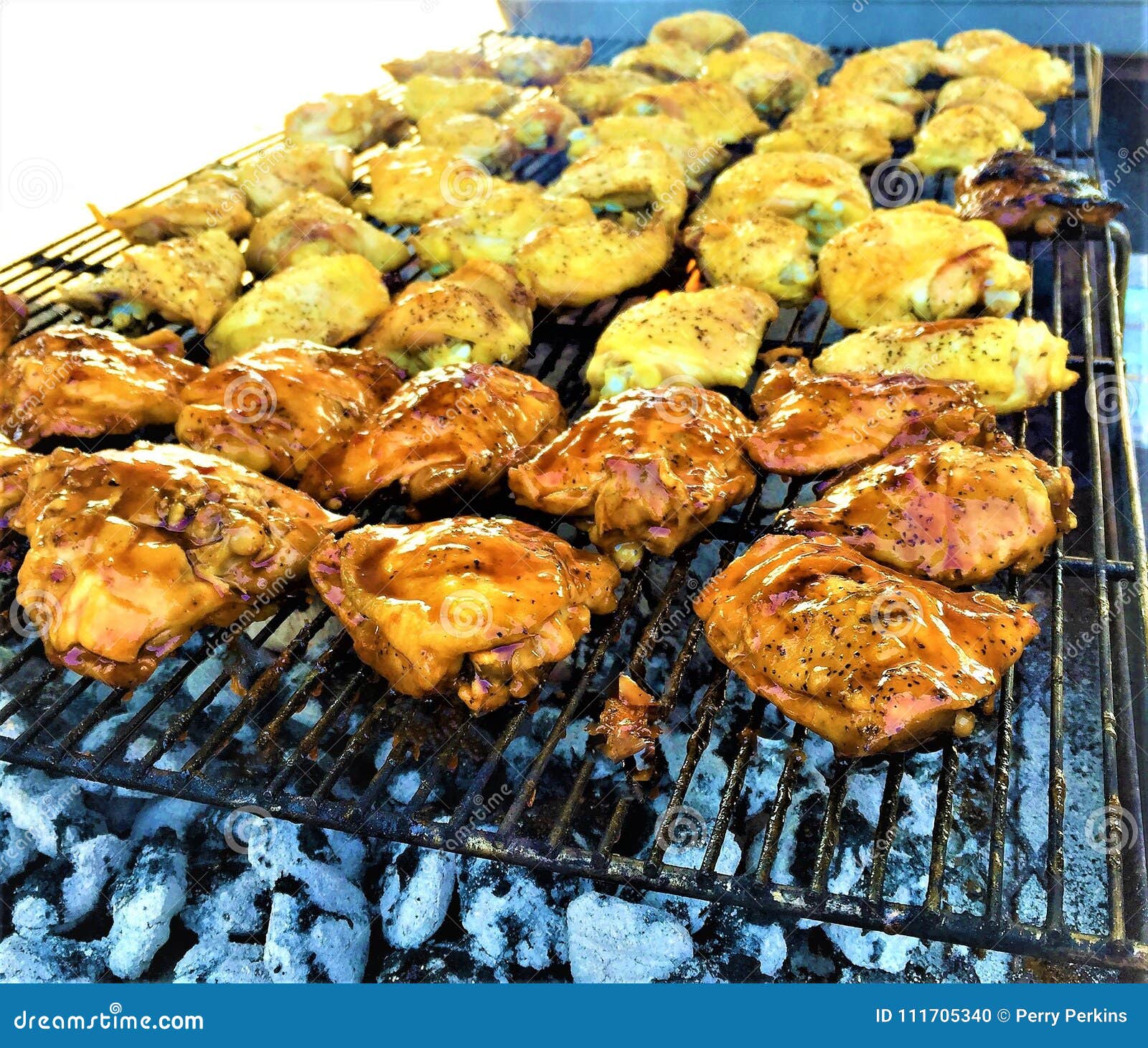
Chicken breasts get all the marketing, but let’s be real for a second. They’re finicky, they dry out if you blink, and they usually taste like whatever bottled sauce you drowned them in. If you actually want to enjoy your backyard cookout, BBQ grilled chicken thighs are the only logical choice. They’re forgiving. They’re fatty in all the right ways. Honestly, it’s almost hard to mess them up, yet people still find ways to turn them into rubbery, charred messes.
I’ve spent years hovering over charcoal and propane, and if there’s one thing I’ve learned, it’s that the "low and slow" mantra is often applied to the wrong things. You don’t need twelve hours for a thigh. You just need to understand how rendered fat interacts with fire.
The Bone-In vs. Boneless Debate
Most people grab the boneless, skinless packs because they’re "easier." They’re wrong. Well, they aren't wrong about the speed—boneless thighs cook in about 12 to 15 minutes—but they are sacrificing the best part of the BBQ grilled chicken thighs experience: the skin.
When you leave the skin on, it acts as a self-basting localized environment. As the heat rises, the subcutaneous fat renders out, keeping the meat beneath it incredibly moist while the exterior transforms into a salty, crispy wafer. If you go boneless and skinless, you’re basically just grilling a small, dark-meat version of a breast. It’s fine, sure. But it isn't great.
J. Kenji López-Alt, a guy who actually understands the science of the kitchen, has often pointed out that bones don’t necessarily "add flavor" to the meat itself in a short cook, but they do act as insulators. This means the meat right next to the bone stays tender while the outside gets that nice sear. It’s about thermal mass.
Temperature is the only thing that matters
Forget the "poke test." Don't look at the color of the juices. If you are serious about BBQ grilled chicken thighs, you need an instant-read thermometer like a Thermapen or even a cheap $15 version from the hardware store.
Here is the secret most people miss: The USDA says chicken is safe at 165°F. For a chicken breast, 165°F is the cliff’s edge; go over, and it's sawdust. But thighs? Thighs have significantly more connective tissue. If you pull a thigh at 165°F, it can sometimes feel a bit "rubbery" or tight.
Try taking your thighs to 175°F or even 185°F.
It sounds crazy, right? Overcooking on purpose? But at these higher temperatures, the collagen in the dark meat fully breaks down into gelatin. This is what gives great BBQ its silky, lip-smacking texture. Because thighs have a higher fat content, they won’t dry out like a breast will at that temp. You get a better mouthfeel and a bone that pulls away clean.
Stop Burning Your Sauce
This is the biggest mistake in the history of backyard grilling. You see it every Saturday: someone slathers cold BBQ sauce onto raw chicken the second it hits the grates.
Don't do that.
Most commercial BBQ sauces—think Sweet Baby Ray’s or even the boutique stuff—are loaded with sugar or molasses. Sugar burns at roughly 265°F. Your grill is likely sitting at 400°F or higher. If you put that sauce on too early, it doesn't caramelize; it carbonizes. You end up with a black, bitter crust and raw meat inside.
The 10-Minute Rule
Basically, you want to grill your chicken until it is about 5 degrees away from your target temperature. Only then do you start painting on the sauce. You want just enough time for the heat to set the sauce into a tacky, lacquer-like glaze. Two or three thin coats are always better than one thick gloop that just slides off into the coals and causes a flare-up.
The Flare-Up Problem
Speaking of flare-ups, BBQ grilled chicken thighs are notorious for causing them. All that delicious fat has to go somewhere. When it hits the flavorizer bars or the coals, it ignites.
You need two-zone cooking. This isn't optional.
Keep one side of your grill hot and the other side completely off (or with no coals). Start your thighs skin-side down over the direct heat to get some color, but the moment the flames start licking the meat too aggressively, move them to the "cool" side. Close the lid. Let the ambient heat do the work. It’s basically turning your grill into a wood-fired oven. This prevents that "sooty" taste that ruins perfectly good poultry.
Brining: Is it worth the effort?
Honestly? Usually no. Not for thighs.
A dry brine—just salt and maybe some pepper or garlic powder—left on the skin in the fridge for a few hours is a game changer for skin texture. It draws out moisture so the skin can crisp. But a wet brine? It often makes the meat a bit "hammy" or spongy. If you're in a rush, just salt them 15 minutes before they hit the fire. It’s enough.
Why Quality Matters
I’m not a snob, but if you buy the cheapest, water-chilled chicken in the big plastic bin, you’re going to have a hard time. Those birds are often injected with a saline solution to "plump" them up. When you grill them, all that water leaks out. You end up steaming the meat instead of searing it. Look for "air-chilled" chicken. It’s a bit more expensive, but the flavor is actually concentrated in the meat rather than diluted by a salt-water bath.
Real-World Steps for Your Next Cookout
Don't overcomplicate the rub. Salt, heavy black pepper, maybe a hit of smoked paprika for color. If you’re using a gas grill, throw a small foil packet of wood chips on the burner cover to get a hint of smoke. It’s not a smoker, but it helps.
- Prep the bird. Pat the thighs bone-dry with paper towels. Seriously, get them dry. Moisture is the enemy of the sear.
- Salt early. If you have an hour, salt them and leave them uncovered in the fridge.
- The Sear. Place them skin-side down over medium-high heat. Don't touch them. Let the fat render. If a fire starts, move them.
- The Flip. Once the skin is golden and releases easily from the grate, flip them to the indirect (cool) side.
- The Stall. Close the lid and wait until they hit 170°F internal.
- The Glaze. Brush on your sauce. Give it 2-3 minutes per side to get sticky.
- The Rest. This is the part everyone skips. Give the chicken 5 to 10 minutes on a cutting board before you bite in. If you cut it immediately, all that hard-earned juice runs out, and you're left with a sad, dry piece of meat.
Chicken thighs are the workhorse of the BBQ world. They don't demand the ego of a brisket or the delicate touch of a filet mignon. They just want a little respect for their fat content and a thermometer to make sure they hit that sweet spot where the collagen melts. Get the skin crispy, keep the sauce for the end, and stop worrying so much about the clock. Your taste buds will thank you.