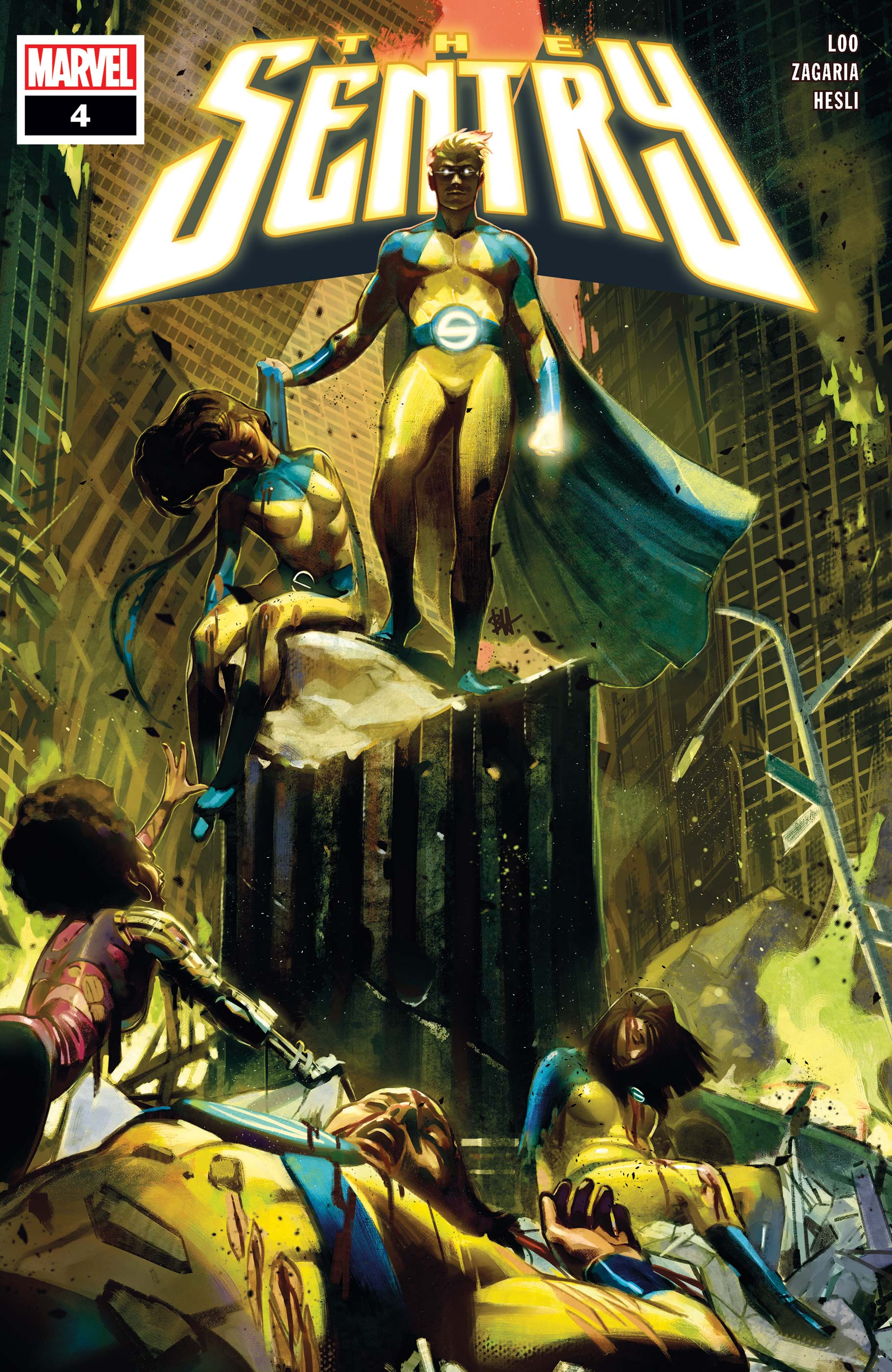
Robert Reynolds is a mess. Most people look at a guy with the power of "a million exploding suns" and think of Superman, but Marvel Comics' The Sentry isn't Clark Kent. Not even close. If you’ve spent any time digging through back issues from the early 2000s, you know that Bob is basically what happens when you give god-tier cosmic power to a man struggling with severe agoraphobia and a fractured psyche. It's messy. It's violent. Honestly, it's one of the most daring meta-narratives Marvel ever pulled off, and yet, a lot of casual fans still don't quite get why he's so divisive.
The Sentry didn't just appear in the Marvel Universe; he was retroactively "remembered" into it. Paul Jenkins and Jae Lee pulled off this brilliant marketing stunt in 2000, claiming that Stan Lee had forgotten a character he created before the Fantastic Four. It was a lie, obviously. But within the story, it was the truth. Everyone—Reed Richards, Peter Parker, even the readers—had forgotten Bob Reynolds existed because he had to erase himself from the world’s memory to stop his dark half, The Void.
The Golden Guardian vs. The Void: A Package Deal
You can't talk about The Sentry without talking about the monster under the bed. The Void is Bob’s shadow. For every life The Sentry saves, The Void is destined to take one. It’s a cosmic balance that makes Bob’s heroism feel more like a curse than a gift. Unlike most villains, The Void isn't just a guy in a suit or an alien from another dimension; it is an extension of Bob's own mental illness given physical, world-ending form.
Think about the stakes for a second. When Robert Reynolds flies into a fight, he’s not just worried about the villain. He’s terrified that if he pushes too hard, the "dark man" will come out and level Manhattan. This is why he spent so much time hiding in his Watchtower or just sitting on his couch while the world burned. He wasn't being lazy. He was being responsible.
In the New Avengers run by Brian Michael Bendis, we see how the hero community reacts to him. They don't just respect him; they’re scared of him. Emma Frost had to reach into his mind just to keep him functional, and even she was shaken by what she found in there. Bob’s power is basically limitless, but his stability is nonexistent. He’s a glass cannon, except the glass is made of nuclear warheads.
That Time He Ripped Ares in Half
If you want to understand the raw, terrifying power of Marvel Comics' The Sentry, you have to look at the Siege event. This wasn't some friendly sparring match. Under the influence of Norman Osborn, Bob finally snapped. He flew through Asgard—the actual home of gods—and tore it out of the sky.
The most infamous moment? He grabbed Ares, the God of War, and literally pulled him apart in front of everyone. No gadgets. No magic spells. Just raw, terrifying strength. This was the moment Marvel showed us that The Sentry isn't a hero in the traditional sense. He's a force of nature that we just happen to hope stays on the "good" side. Ares was a heavy hitter, a guy who had gone toe-to-toe with Hercules and Thor, and Bob treated him like a piece of wet paper.
Why Marvel Writers Struggle With Him
It’s hard to write a character who can end any fight in two seconds. If The Sentry is on the team, why does Spider-Man need to worry about the Sinister Six? Why does Iron Man need a new suit? Most writers handle this by focusing on Bob’s mind rather than his fists. Jeff Lemire’s 2018 run did a fantastic job of this, creating a "Sentry World" where Bob could live out his hero fantasies without hurting the real world.
But it always falls apart.
The tragedy of Robert Reynolds is that he can never just be a person. He’s either a god or a monster, and usually, he’s both at the same time. This is why he’s often sidelined in major events or "killed off" only to return when a writer needs a massive power boost for a story. He’s a difficult toy to play with because he breaks the game.
The Addiction Meta-Narrative
One of the more grounded theories about the character—and something Jenkins leaned into—is that Bob’s origin is a metaphor for addiction. In some versions of his story, he didn't get his powers from a "Secret Golden Sentry Serum" by accident. He was looking for a high. He was a drug addict who broke into a lab and drank something he shouldn't have.
This adds a layer of grime to the shining hero. It makes his struggle with The Void feel like a struggle with relapse. Every time he uses his power, he’s "using," and the comedown is The Void. If you look at it through that lens, his agoraphobia and his desperate need for approval from figures like Captain America make a lot more sense. He’s a guy in recovery who just happens to be able to punch a hole through a planet.
The MCU Problem: Can He Work on Screen?
With rumors always swirling about The Sentry appearing in the Marvel Cinematic Universe (specifically in the Thunderbolts* film), the big question is how you adapt someone so internal. A lot of his best stories happen inside his own head.
You can't just have him be "Marvel's Superman." That would be boring and, frankly, a waste of the character. To do him justice, the MCU needs to lean into the horror. We need to see the fear in the eyes of the other heroes when he shows up. If the audience isn't a little bit afraid of him, then it's not really The Sentry.
- The Costume: It needs to look slightly off. Not the sleek, perfect spandex of the Avengers, but something that feels like a costume a mentally ill man put together to convince himself he’s a hero.
- The Sound: The "million exploding suns" shouldn't just be a line of dialogue. It should be a deafening, uncomfortable sound design choice whenever he’s on screen.
- The Void: Don't make it a CGI monster. Make it a presence. Make it feel like the lighting in the room changes when Bob gets angry.
Misconceptions People Still Have
A lot of people think The Sentry is a rip-off of Superman. It’s a surface-level comparison that doesn't hold up under any actual scrutiny. Superman is defined by his upbringing and his unwavering moral compass. Bob Reynolds is defined by his trauma and his lack of a compass.
Another big one? That he’s just "crazy." That’s a reductive way to look at a character dealing with Dissociative Identity Disorder and Schizophrenia. His mental health isn't a plot device; it is the plot. When writers treat his condition as a "power nerf," the stories usually suck. When they treat it as a fundamental part of who he is, that’s when we get classics.
How to Get Into Sentry Comics Without Getting Lost
If you're looking to actually read this stuff, don't just jump into the middle of a massive crossover event. You’ll be confused. Start with the original The Sentry (2000) miniseries. It’s self-contained and sets up the whole "forgotten hero" vibe perfectly.
After that, check out New Avengers: Breakout. It shows how he fits (or doesn't fit) into a team. If you want something more modern and psychological, the Lemire run is the way to go. It deals with the legacy of the character and the reality of living with that much power in a way that feels very "prestige TV."
Skip the stuff where he’s just used as a blunt instrument. Look for the stories where he’s talking to his wife, Lindy, or arguing with his dog, Barnabas. That’s where the real character lives. The Sentry is at his best when he’s at his most human and, ironically, his most pathetic.
Actionable Insights for the Modern Fan
- Read between the lines: When reading Marvel Comics' The Sentry, pay attention to the art style changes. Artists often use different line weights or color palettes to signal when Bob is losing his grip or when The Void is manifesting.
- Context is everything: Research the "Sentry Fake-Out" of 2000. Understanding the real-world marketing (magazines printing fake history about the character) makes the in-universe story of people forgetting him much more impactful.
- Watch the background: In large group scenes in comics like Civil War or World War Hulk, look at where The Sentry is standing. Usually, he’s off to the side, looking conflicted. It’s a great bit of visual storytelling regarding his hesitation to join the fray.
- Compare and Contrast: Read The Sentry alongside Miracleman by Alan Moore. There are massive thematic overlaps regarding the "superman" archetype and the toll it takes on a regular person's mind.
Robert Reynolds isn't a hero you should want to be. He's a cautionary tale wrapped in a gold cape. He reminds us that power doesn't fix your problems; it just makes them everyone else's problems too. Whether he’s tearing a god in half or hiding in his basement, he remains the most fascinating, broken mirror the Marvel Universe has ever held up to itself.
To truly understand the Sentry's impact, you have to look at how he changed the power scaling of the Marvel Universe. Before him, Thor and Hulk were the ceiling. After Bob, the ceiling was gone. But that power came at a price that most heroes aren't willing to pay. It’s a narrative tightrope that Marvel continues to walk, and as long as they keep the focus on the man inside the suit, he’ll always be worth reading.
Find a copy of the original 2000 trade paperback. Look at Jae Lee’s haunting art. Notice how Bob’s eyes never quite look like they’re seeing the same world as everyone else. That’s the key to the character. He’s always somewhere else, fighting a war we can’t see, hoping that today isn't the day the suns finally explode.