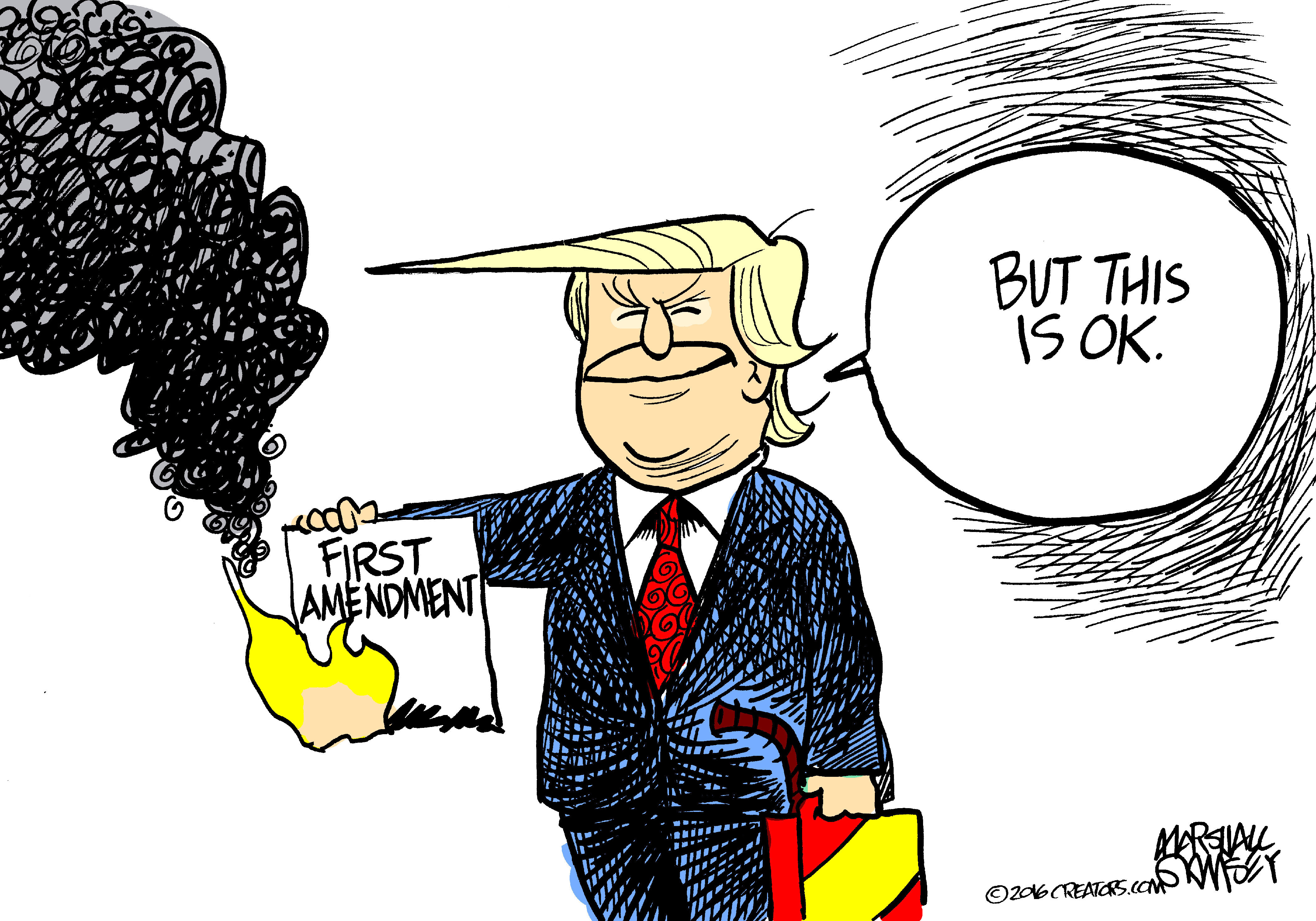
You’ve probably seen a caricature of a president with an oversized nose or a local mayor portrayed as a literal garbage fire. It’s a staple of American life. But have you ever stopped to wonder why the artist isn't in jail? Honestly, in most parts of the world, mocking a powerful leader gets you a one-way ticket to a dark cell. In the United States, however, the political cartoon 1st amendment connection is basically a legal suit of armor. It’s what allows a pen to be mightier than a politician’s ego.
Satire is messy. It’s often rude. Sometimes, it’s downright offensive. Yet, the Supreme Court has made it incredibly clear that being offensive isn't just a right—it’s a necessity for a functioning democracy. If we couldn't laugh at the people in charge, we'd probably be a lot more afraid of them.
The Supreme Court Case That Changed Everything
Most people think free speech is just about talking. It’s not. It’s about symbols, drawings, and even the "vibes" of a message. The big turning point for the political cartoon 1st amendment relationship happened in 1988. The case was Hustler Magazine, Inc. v. Falwell. It’s a wild story. Larry Flynt, the publisher of Hustler, ran a "parody" ad that suggested the Reverend Jerry Falwell had a drunken, incestuous encounter with his mother in an outhouse.
It was crude. It was mean-spirited. It was definitely not "news." Falwell sued for intentional infliction of emotional distress. He actually won at the lower court level. But when it hit the Supreme Court, the justices did something fascinating. They ruled 8-0 in favor of the magazine. Chief Justice William Rehnquist—who wasn't exactly known for being a radical hippie—wrote that the First Amendment protects even "vehement, caustic, and sometimes unpleasantly sharp attacks."
Why? Because if a public figure could sue every time their feelings were hurt by a drawing, political cartoonists would go extinct. The Court recognized that the "outrageousness" of a cartoon is subjective. What I find funny, you might find disgusting. If the law tried to police "outrageousness," the government would become the ultimate art critic. That’s a terrifying thought.
Why "Truth" Doesn't Work the Same Way in Cartoons
In a standard libel case, truth is the ultimate defense. If I say you stole a car and you actually did, I’m safe. But political cartoons aren't trying to tell the literal truth. Nobody actually thinks a senator has three heads or that the tax code is a literal giant vacuum cleaner sucking money out of a house.
We call this "rhetorical hyperbole."
Basically, the law acknowledges that cartoons use metaphors. When an artist draws a politician as a puppet, they aren't accusing them of being made of wood and string. They are making a point about influence. Because no reasonable person would view these drawings as factual assertions, they can't be "false" in a legal sense. This gives artists a massive amount of breathing room. You’ve got the right to be hyperbolic. You’ve got the right to use symbols that are factually impossible to convey a deeper, political truth.
The Lines You Actually Can't Cross
Now, don't get it twisted. A cartoonist doesn't have a "get out of jail free" card for everything. There are limits. They're just very, very high.
- Incitement to Violence: If a cartoon explicitly tells people to go burn down a specific building at 4:00 PM today, that’s not protected speech. That’s "incitement to imminent lawless action," a standard set by Brandenburg v. Ohio.
- True Threats: A drawing that a reasonable person would interpret as a serious intent to harm someone isn't protected.
- Copyright Infringement: You can't just draw Mickey Mouse endorsing a candidate and expect Disney’s lawyers to stay home. While "parody" is a defense in copyright law, it's a complicated legal dance.
Honestly, the biggest threat to cartoonists today isn't the law. It's the market.
The Death of the Staff Cartoonist
It’s a grim time for the profession. Thirty years ago, every major newspaper had a staff cartoonist. Today? There are only a handful left. When the New York Times stopped running political cartoons in its international edition back in 2019, it sent shockwaves through the industry. The move came after an outcry over a cartoon depicting Benjamin Netanyahu and Donald Trump that many labeled as antisemitic.
This is the nuance of the political cartoon 1st amendment debate. Just because the government can't censor you doesn't mean your editor has to publish you. Private companies have their own First Amendment rights, which include the right to decide what they don't want to print. We’re seeing a shift where the "censorship" is coming from HR departments and social media mobs rather than judges.
Social Media and the "Context Collapse"
In the old days, a cartoon lived in a newspaper. You knew the context. You knew the artist’s history. Today, a cartoon gets screenshotted, cropped, and shared on X (formerly Twitter) or TikTok. It loses its context instantly.
This leads to what researchers call "context collapse." A drawing meant to satirize a specific policy suddenly looks like a generic attack on a protected group. When a cartoon goes viral for the wrong reasons, the backlash is instant and overwhelming. Many artists are now self-censoring. They aren't afraid of the Supreme Court; they're afraid of losing their Patreon supporters or getting their accounts banned.
Thomas Nast and the Power of the Pen
To really understand why we protect these drawings so fiercely, you have to look at Thomas Nast. He’s the guy who popularized the Republican Elephant and the Democratic Donkey. In the 1870s, he went after "Boss" Tweed, the corrupt leader of Tammany Hall in New York City.
Tweed famously said, "Stop them damn pictures. I don't care so much what the papers say about me—my constituents can't read; but damn it, they can see pictures!"
That’s the core of it. Political cartoons democratize dissent. You don't need a PhD or a high reading level to understand a well-executed caricature. You just need eyes. By protecting the political cartoon 1st amendment rights of artists, we are protecting a form of communication that reaches people who might otherwise be ignored by the "intellectual" political discourse.
Is Satire Still Effective in a Post-Truth World?
Some people argue that satire is dead. How do you satirize a world that already feels like a parody? When politicians say things that are more "outrageous" than what a cartoonist could dream up, the medium struggles.
But I’d argue it’s more important than ever. Cartoons provide a visual shorthand for complex issues. They cut through the noise. A single image of a child’s backpack lying near a border wall or a CEO sitting on a mountain of cash while employees use food stamps says more than a 5,000-word op-ed ever could.
Protecting Your Own Speech
If you’re an aspiring artist or just someone who likes to share political memes, you need to know where you stand. The digital age has blurred the lines between "professional cartoonist" and "person with a smartphone."
- Understand Parody vs. Satire: Legally, parody mimics a specific work to poke fun at it, while satire uses humor to criticize a broader social issue. Both are generally protected, but parody has stronger protections in copyright law.
- Public Figures Have a Higher Bar: If you draw a caricature of your neighbor, they might have a case for defamation if you imply they’re a criminal. If you draw the President, you’re almost always safe. Public figures have to prove "actual malice"—meaning you knew what you were saying was false or you acted with reckless disregard for the truth.
- Watch the Platform Rules: Your First Amendment rights stop where a Terms of Service agreement begins. Meta, ByteDance, and X can remove your art for "hate speech" or "misinformation" even if a court would find it perfectly legal.
Moving Forward with the First Amendment
The political cartoon 1st amendment relationship is a living thing. It’s not just words on a dusty piece of parchment from 1791. It’s a shield that we’ve forged through decades of legal battles, from the smut of Hustler to the biting wit of The Onion.
If you want to support this tradition, the best thing you can do is engage with it. Follow independent cartoonists on Substack. Support local alt-weeklies that still give space to visual satirists. Don't immediately join the dogpile when a cartoon offends you—instead, ask yourself what the artist was trying to say.
Next Steps for Protecting Expression:
- Review the "Actual Malice" Standard: Read up on New York Times Co. v. Sullivan. It’s the bedrock of why we can criticize powerful people without fear.
- Support Visual Literacy: Teach others (especially younger generations) how to "read" a cartoon. Identify the symbols, the exaggerations, and the underlying message.
- Diversify Your Feed: Follow artists from different political backgrounds. The First Amendment works best when it's protecting speech we hate, not just the speech we agree with.
The pen remains a dangerous weapon. That’s exactly why the law keeps it sharp. In an era of AI-generated imagery and deepfakes, the intentional, human-driven perspective of a political cartoon is a vital check on power. Don't let the noise of the internet make you forget that.