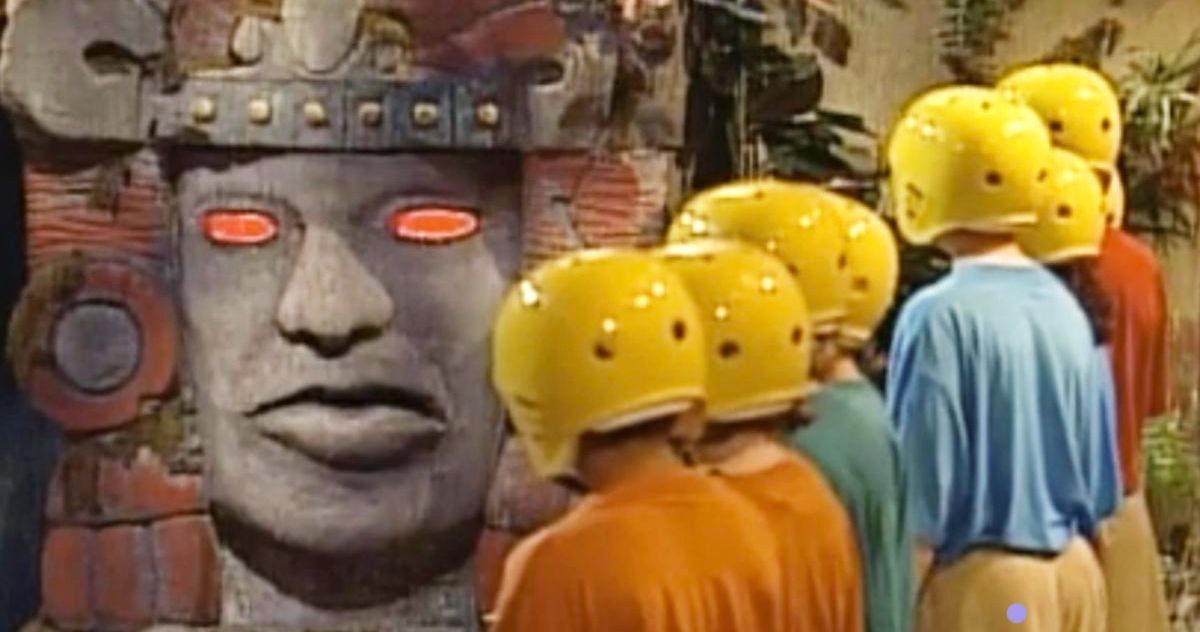
The floor was literally lava. Or at least, that’s how it felt to every kid sitting cross-legged in front of a tube TV in 1993, screaming at a pre-teen on screen who couldn't figure out how to put a three-piece silver monkey together. It was infuriating. It was stressful. Honestly, it was probably the most high-stakes thing most of us had ever seen. Legend of the Hidden Temple wasn't just another game show; it was a physical manifestation of every Indiana Jones fever dream we ever had, wrapped in the sweat-soaked aesthetics of a Florida soundstage.
You remember the teams. The Purple Parrots. The Blue Barracudas. The Red Jaguars. If you were a Green Monkey fan, you were probably a bit of an underdog lover. Each episode of Legend of the Hidden Temple followed a strict, brutal hierarchy of physical and mental elimination that culminated in the "Temple Run," a three-minute dash through a foam-and-fiberglass labyrinth that felt miles wide but was actually packed into a relatively small space at Nickelodeon Studios in Orlando.
But why does this show specifically stick in the craw of Gen X and Millennials? Most game shows fade into the background noise of nostalgia. This one didn't. It stuck because it was genuinely hard. It wasn't "everyone wins a trophy" television. Most of the time, the kids lost. They got caught by Temple Guards, they ran out of time, or they simply crumbled under the pressure of Kirk Fogg’s frantic play-by-play. It felt real because the failure was real.
The Brutality of the Shrine of the Silver Monkey
If you want to talk about the core trauma of 90s television, you start with that monkey. It had three pieces. Head, torso, base. That’s it. Yet, the Shrine of the Silver Monkey is arguably the most famous room in the entire temple because of how many kids absolutely choked there. You’d see a kid fly through the Pit of Despair, dodge a Temple Guard in the Medusa Lair, and then spend forty-five seconds trying to put the head on the bottom of the monkey.
It was agonizing.
But there’s a reason for it that most people don't realize. These kids were exhausted. By the time they reached the temple, they had already competed in the Moat crossing, the Steps of Knowledge, and the Temple Games. Their adrenaline was red-lining. Add in the fact that the temple was dark, damp, and filled with crew members in scary masks jumping out from behind false walls, and you have a recipe for total cognitive shutdown.
The Temple Guards were a unique psychological horror. You had to have a Pendant of Life to survive an encounter, and even then, the "hand-off" took precious seconds. If you were out of pendants, you were gone. Gone! No second chances. The stakes were incredibly high for a prize that was often just a pair of Skechers or a trip to a Space Camp that might not even be in your home state.
Olmec and the Art of the Backstory
The giant talking head, Olmec, was voiced by the legendary Dee Bradley Baker. You’ve heard his voice in a thousand things since—he’s every Clone Trooper in Star Wars, he’s Appa in Avatar: The Last Airbender—but to us, he was the stony gatekeeper of Mayan-ish mythology. Olmec provided the "Legend" part of Legend of the Hidden Temple.
The stories were usually loosely based on historical figures or myths: The Golden Cup of Belshazzar, The Pearl Buggy of Quetzalcoatl, The Star of Polaris. They weren't always 100% historically accurate, let's be honest. It was a 90s kids' show. But it gave the physical competition a narrative weight. You weren't just running through a maze; you were recovering a lost artifact to appease a giant stone head.
The "Steps of Knowledge" served as a filter. If you weren't paying attention to the story, you didn't move on. It rewarded the kids who could actually focus amidst the chaos. It’s funny looking back at how some teams would just guess wildly. You’d see the Orange Iguanas buzz in before the question was even half-finished, get it wrong, and then just sink into the floor. Brutal.
The Logistics of a Failed Temple Run
Ever wonder why the Temple Run looked so cramped? It was. The set was a masterpiece of 90s production design, but it was essentially a giant puzzle box. There were twelve rooms, and they changed the "path" every episode. One day the door to the Room of the Ancient Warriors would be locked; the next, you had to crawl through the Tubes of Fear.
Production was grueling. They would often film five episodes a day. The "water" in the Moat was notoriously gross by the end of a filming week. Kirk Fogg has mentioned in various interviews over the years that the kids were often genuinely terrified. It wasn't just stage fright. It was the "Temple Guard" factor. Imagine being 12 years old, sprinting through a dark room, and a 6-foot-tall man in a loincloth and a mask jumps out of a tree to grab you.
- The Moat: Usually involved some kind of rope swing or unstable raft.
- The Steps: A trivia-based elimination.
- The Temple Games: Three physical challenges to win Pendants of Life.
- The Temple Run: The final boss.
Most contestants never even saw the inside of the temple. Only six teams started, and only one got the chance to run. The win rate was surprisingly low. According to various fan trackers, only about 30 or so teams actually "conquered" the temple across the show's original three-season run. That’s a dismal success rate for a kids' show. But that’s what made the wins feel like a Super Bowl victory.
Why the Reboots Struggle to Capture the Magic
Nickelodeon tried to bring it back. They did a movie. They did an "adult" version on The CW. And while the nostalgia was there, something was missing. Maybe it's the fact that we're all older and we see the "Temple Guards" as just underpaid actors in costumes now. Or maybe it’s because modern TV is too polished.
The original Legend of the Hidden Temple felt DIY. It felt like something you and your friends could build in a backyard if you had enough cardboard and a very patient uncle to play Olmec. It had a grit to it. The cameras were shaky. The kids were sweaty and had their helmets on crooked. It was authentic chaos.
Also, the "Adult" version took away the innocence. Seeing a 28-year-old struggle with the Silver Monkey isn't tragic; it's just sad. When a 12-year-old does it, it's a rite of passage. We were all that kid. We all believed we would be the one to finally find the King's Shilling and get out of there with time to spare.
The Cultural Legacy of the Hidden Temple
You see the shirts everywhere now. Go to any music festival or dive bar, and you’ll spot a faded Blue Barracudas tee. It’s a secret handshake for a specific generation. It represents a time when Nickelodeon was the center of the universe and when "adventure" meant a soundstage in Orlando.
The show taught us a few things, albeit harshly. It taught us that sometimes the door is locked and you just have to turn around. It taught us that pressure can make you forget how a basic puzzle works. And it taught us that a giant stone head is a pretty cool narrator.
If you’re looking to dive back into the world of Olmec, there are a few things you can actually do to scratch that itch without just watching low-res YouTube clips.
- Check out the Paramount+ archives: They have the original runs. Watch them with the eyes of an adult and you'll see just how many "close calls" were actually the result of production timing.
- Listen to Dee Bradley Baker’s interviews: He’s incredibly open about his time on the show and how he developed the voice of Olmec. It adds a whole new layer of appreciation for the craft.
- Analyze the Temple Layouts: There are fan-made maps online that show how the rooms connected. It’s a masterclass in small-space set design.
- Find the "Lost" contestants: A few former contestants have done AMAs on Reddit. Their stories about the "behind the scenes" smell of the moat and the intensity of Kirk Fogg are gold.
The temple is closed, but the legend? That’s not going anywhere. It’s baked into our DNA, right next to the theme song from Rugrats and the taste of orange soda. We’re all just still trying to put that monkey together.
To get the most out of your nostalgia trip, try watching an episode and timing the Temple Run yourself. You'll quickly realize that the "three minutes" was often edited for TV, making the wins even more impressive and the losses even more devastating. For a real deep dive, look for the "Purple Parrots" episode where the contestant famously threw the artifact back into the room she just left—it's a perfect case study in the "Temple Fog" that affected so many young minds.